
UNESCO World Heritage Sites in Morocco
Heritage Overview
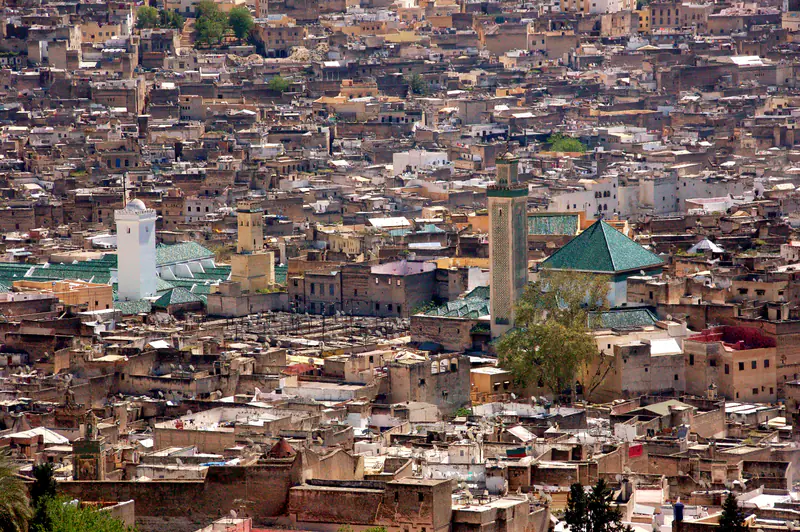
Morocco stands at the crossroads of Africa, Europe, and the Arab world, creating a heritage landscape of remarkable diversity shaped by Berber, Arab, Andalusian, and Mediterranean influences across millennia. Ancient imperial cities preserve extraordinary examples of Islamic architecture and urban planning that continue to function as living centers of traditional craftsmanship and commerce. The country's strategic position along trans-Saharan trade routes fostered prosperous dynasties that invested in monumental religious and civic architecture. Intricate geometric patterns, carved stucco, cedar woodwork, and colorful *zellij* tilework demonstrate artistic traditions refined over centuries. Traditional medinas remain vibrant urban environments where historic building techniques and artisanal practices continue unbroken from medieval times. Morocco actively preserves both tangible monuments and intangible cultural heritage including traditional crafts, music, and oral traditions recognized by UNESCO. The nation balances tourism development with conservation efforts, recognizing that sustainable heritage management supports local communities economically while protecting irreplaceable cultural assets. Moroccan expertise in earth construction and traditional water management systems contributes valuable knowledge to international conservation practice.
Essential Information
Visa Requirements
Citizens of the United States, European Union countries, United Kingdom, Canada, Australia, and many other nations can enter Morocco visa-free for stays up to 90 days. Passports must be valid for at least six months beyond the date of entry. No visa extension is possible within Morocco; travelers must exit and re-enter for a new 90-day period. Entry stamps are placed in passports upon arrival. For longer stays, appropriate visas must be obtained through Moroccan consulates before travel. Business travelers should verify specific requirements for their activities.
Currency
The official currency is the Moroccan Dirham (MAD), a partially convertible currency not available outside Morocco. ATMs are widely available in cities and tourist areas, accepting international cards (Visa, Mastercard). Credit cards are accepted at hotels, restaurants, and larger shops, though cash is essential for medinas, souks, and smaller establishments. Exchange offices are found at airports, banks, and tourist areas. Always negotiate prices in dirhams, not foreign currency. Keep small denominations for tips and small purchases. Re-converting dirhams before departure is difficult, so budget accordingly.
Language
Arabic and Berber (*Amazigh*) are official languages, with Moroccan Arabic (*Darija*) spoken daily. French is widely used in business, tourism, and urban areas—most heritage site information is available in Arabic and French, often with English translations. Spanish is common in northern regions. English proficiency is growing in tourist areas but limited elsewhere. Learning basic phrases (*shukran* for thank you, *la* for no, *na'am* for yes) enhances interactions. Guides at major heritage sites typically speak multiple languages including English.
Climate
Morocco's climate varies dramatically by region. Coastal areas enjoy Mediterranean conditions with mild winters (12-18°C) and warm summers (25-30°C). Interior cities like Fez and Marrakech experience continental extremes—hot summers exceeding 40°C and cool winters around 8-15°C. Spring (March-May) and autumn (September-November) offer ideal temperatures for exploring medinas and heritage sites. Summer heat in interior cities can be intense; plan indoor activities during midday. Winter brings occasional rain. Mountain regions experience snow. Pack layers for temperature variations between day and night.
Featured Heritage Sites
Last updated: 12 December 2025