
Myanmar • UNESCO World Heritage Site
Bagan: Ancient Temple Plains of Myanmar's Buddhist Kingdom
Thousands of Temples Rising from the Irrawaddy Plain
Inscribed: 2019
Category: Cultural
ID: #1588
What Is Bagan and Why Visit?
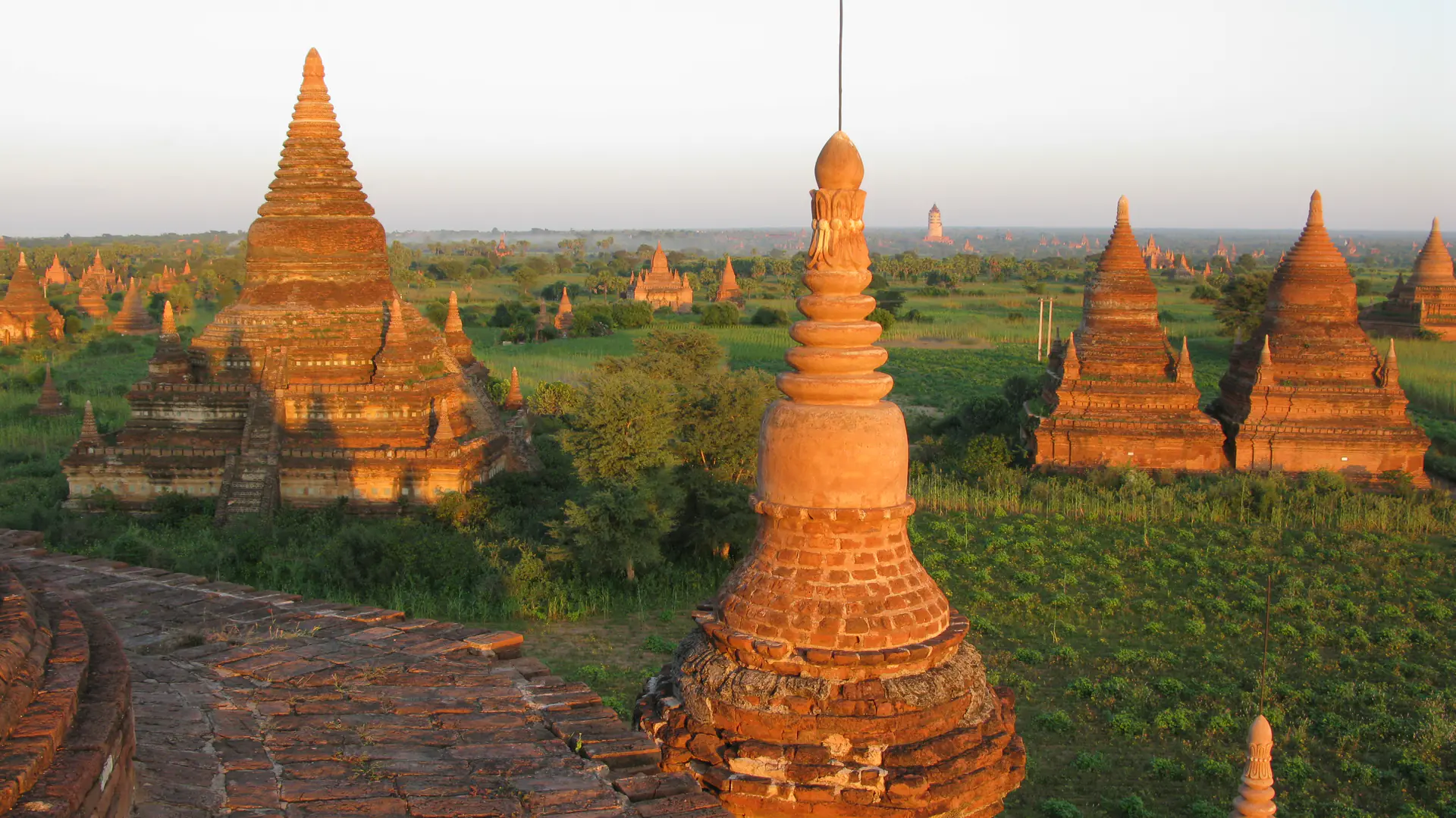
King Anawrahta Minsaw founded the Pagan Kingdom around 1044 CE, establishing a dynasty that transformed these arid plains along the Irrawaddy River into the spiritual heart of Theravada Buddhism. Over 250 years, successive rulers and donors constructed more than 10,000 Buddhist monuments across 104 square kilometers, demonstrating devotion through merit-making promising favorable rebirth. Today 3,595 temples, pagodas, and monasteries survive, their silhouettes punctuating the horizon and creating one of the world's densest concentrations of Buddhist art and architecture. The monuments preserve exceptional murals, sculptures, and inscriptions documenting the cultural flowering of the Pagan period, influencing Buddhist traditions across mainland Southeast Asia. Sunrise and sunset transform the plain into a mystical landscape as hot air balloons drift between ancient spires and local devotees continue centuries-old Buddhist practices at active shrines.
Why It Matters
This sacred landscape bears exceptional testimony to the Pagan civilization and the Theravada Buddhist tradition of merit-making through temple construction. The 3,595 surviving monuments demonstrate outstanding Buddhist art and architecture while preserving inscriptions and murals that document medieval Southeast Asian history and religious practice.
How to Visit Bagan
Essential information for visiting this destination
How to Get to Bagan
Nyaung U Airport receives domestic flights from Yangon (1 hour, approximately $100-150 USD) and Mandalay (30 minutes) on Air KBZ, Myanmar National Airlines, and Golden Myanmar Airlines. The airport lies 4 kilometers from Nyaung U town with taxis to hotels costing 5,000-10,000 MMK ($4-8 USD).
Overnight buses from Yangon (10 hours, $15-25 USD) and Mandalay (5 hours, $10-15 USD) arrive at Nyaung U bus station. Irrawaddy River ferries from Mandalay offer scenic but slow passage (9-10 hours downstream, longer upstream).
Within Bagan, e-bikes (electric scooters) provide ideal temple exploration, costing 6,000-10,000 MMK ($4-8 USD) per day. Motorbikes are prohibited for foreigners. Horse-carts offer traditional transport at higher cost. Bicycle rentals available but demanding in heat. Licensed taxi services and organized tours provide air-conditioned alternatives for those preferring guides.
Best Hotels Near Bagan
Three distinct areas offer accommodation: Nyaung U (budget and mid-range near the airport and Shwezigon Pagoda), Old Bagan (upscale hotels within the archaeological zone near major temples), and New Bagan (mid-range options 4 kilometers south).
Old Bagan provides the most atmospheric setting with properties near Ananda Temple allowing dawn walks to temples, though stricter regulations limit development. Nyaung U offers the widest selection with restaurants, shops, and services convenient for multi-day stays. New Bagan suits travelers seeking modern amenities at lower prices than Old Bagan.
Book ahead during peak season (November-February) when balloon flights operate and weather is optimal. Budget guesthouses start around $20-30 USD, mid-range hotels $50-100 USD, and luxury properties $150-300 USD per night.
Where to Eat Near Bagan
Myanmar cuisine features rice, noodles, and curries reflecting Chinese and Indian influences with distinctive Burmese character. Mohinga (fish noodle soup) represents the national dish, eaten for breakfast throughout the country. Curries use less coconut milk than Thai counterparts, with ngapi (fermented fish paste) providing distinctive flavor. Lahpet thoke (fermented tea leaf salad) offers unique flavors combining tea leaves with crunchy accompaniments.
Nyaung U town offers the best restaurant selection ranging from local teahouses to tourist-oriented establishments. Restaurants overlooking temple plains serve Burmese and international cuisine at sunset. Street food provides authentic and economical eating. Local beer (Myanmar Beer, Mandalay Beer) and palm toddy (htayne ye) accompany meals.
Vegetarian options widely available reflecting Buddhist dietary practices. Avoid tap water; bottled water readily available. Fresh fruits and vegetables plentiful at local markets.
Bagan Entry Fees & Tour Prices
Bagan Archaeological Zone fee costs 25,000 MMK (~$12 USD) or $20-25 USD, valid for 3-5 days. Purchase at airport upon arrival or at ticket counters before entering the zone. Passport required.
Hot air balloon flights operate November-February during cool, clear mornings. Flights cost $300-400 USD for 45-60 minute experiences including champagne breakfast. Book well in advance through operators like Balloons Over Bagan or Oriental Ballooning.
E-bike rental costs 6,000-10,000 MMK ($4-8 USD) per day, available from hotels and shops throughout Nyaung U. Half-day sunrise or sunset rentals cost $5-7 USD. E-bikes reach 40 km/h, sufficient for covering the spread archaeological zone.
Irrawaddy River sunset cruises cost $15-30 USD including drinks. Lacquerware workshops in Myinkaba village demonstrate traditional crafts. Mount Popa day trip (50 km) visits the dramatic volcanic plug and nat spirit shrine. Cooking classes and traditional puppet shows available.
What to Bring to Bagan
Travel insurance covering medical emergencies and evacuation essential for Myanmar given limited healthcare outside Yangon. Current political situation should be monitored before travel decisions. International eSIM cards provide connectivity though signals vary. Myanmar Kyat (MMK) is local currency; USD widely accepted for major payments. ATMs available in Nyaung U but can be unreliable.
November-February offers ideal conditions with temperatures 20-30°C and no rain. March-May brings extreme heat exceeding 40°C. June-October rainy season features afternoon thunderstorms but fewer crowds.
Pack modest clothing for temple visits (covered shoulders and knees), comfortable walking shoes, sun protection, and flashlight for dark interiors. Remove shoes before entering temples. Myanmar Type C/D outlets operate on 230V with power interruptions common.
Temple climbing has been prohibited since January 2018. Use designated viewing mounds for sunrise and sunset photography. Respect religious sensitivities at active shrines.
Loading map...
Visitor Information
Everything you need to know for your visit
What to Bring
Comfortable walking shoes for temple exploration over sandy and dusty terrain. Bring modest clothing covering shoulders and knees for temple visits, with sarong or longyi available for purchase locally. Pack sunscreen, hat, and sunglasses as temples offer limited shade. Carry sufficient water (1-2 liters) as facilities between temples are sparse. Flashlight useful for examining dark temple interiors and murals. Face mask recommended during dusty season.
Accessibility
Bagan presents significant accessibility challenges with uneven sandy terrain, steep temple stairs, and most monuments lacking accessibility features. Some larger temples have ground-floor accessible areas, but upper levels require climbing. E-bikes and horse carts provide transportation alternatives to walking. Temple climbing has been prohibited since January 2018, eliminating previously popular elevated viewing spots. Designated viewing mounds near some temples offer partial accessibility.
Safety Tips
Bagan is generally safe though standard precautions apply. Hot season (March-May) brings extreme temperatures exceeding 40°C requiring careful planning around early morning and late afternoon activities. Temple interior darkness conceals uneven floors and low doorways. Snake awareness needed in less-visited areas. Current political situation in Myanmar should be monitored before travel. E-bikes common transport but helmets rarely provided--exercise caution on sandy roads.
Thousands of Buddhist Monuments Spanning Three Centuries
Must-See
Ananda Temple: Masterpiece of Mon Architecture
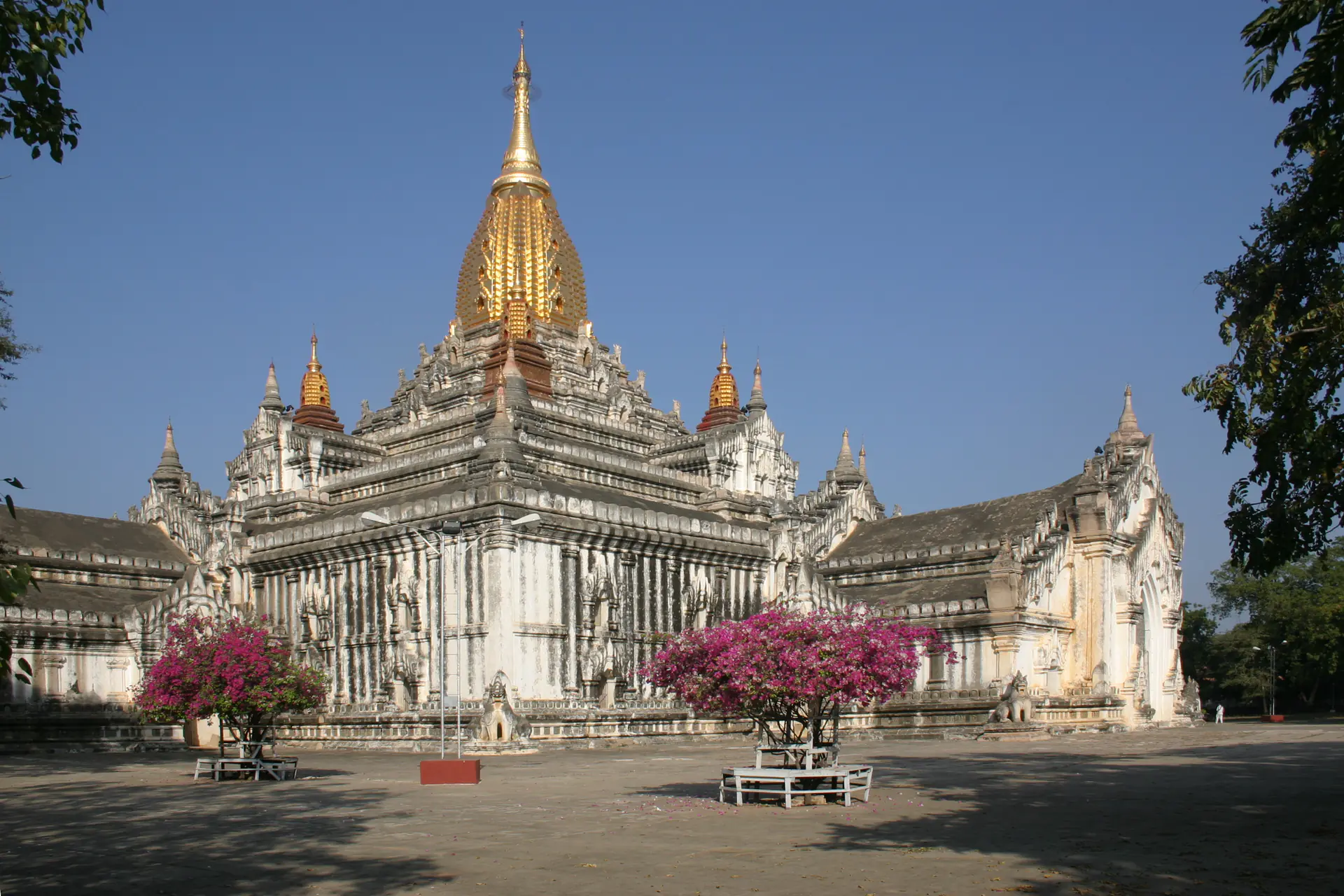
Enter Bagan's most revered temple, a masterpiece blending Mon and Indian traditions inspiring devotion for over 900 years. King Kyansittha commissioned Ananda Temple in 1105, creating a perfect cruciform structure rising 51 meters with gilded spires catching morning light. Four colossal standing Buddha statues, each 9.5 meters tall, face the cardinal directions, with southern and northern statues displaying different expressions when viewed from near and far. The covered corridors contain 80 relief panels depicting the Buddha's life, while upper terraces feature hundreds of glazed tiles illustrating jataka stories. Ananda survived the 1975 earthquake with only its finial damaged, testament to exceptional construction, undergoing restoration with international assistance.
Pro tip: Enter Ananda Temple at the eastern entrance and walk clockwise following traditional Buddhist circumambulation--morning light illuminating the eastern Buddha creates striking photography, while the western Buddha photographs best during golden hour before sunset.
Must-See
Shwezigon Pagoda: Golden Prototype of Myanmar Stupas
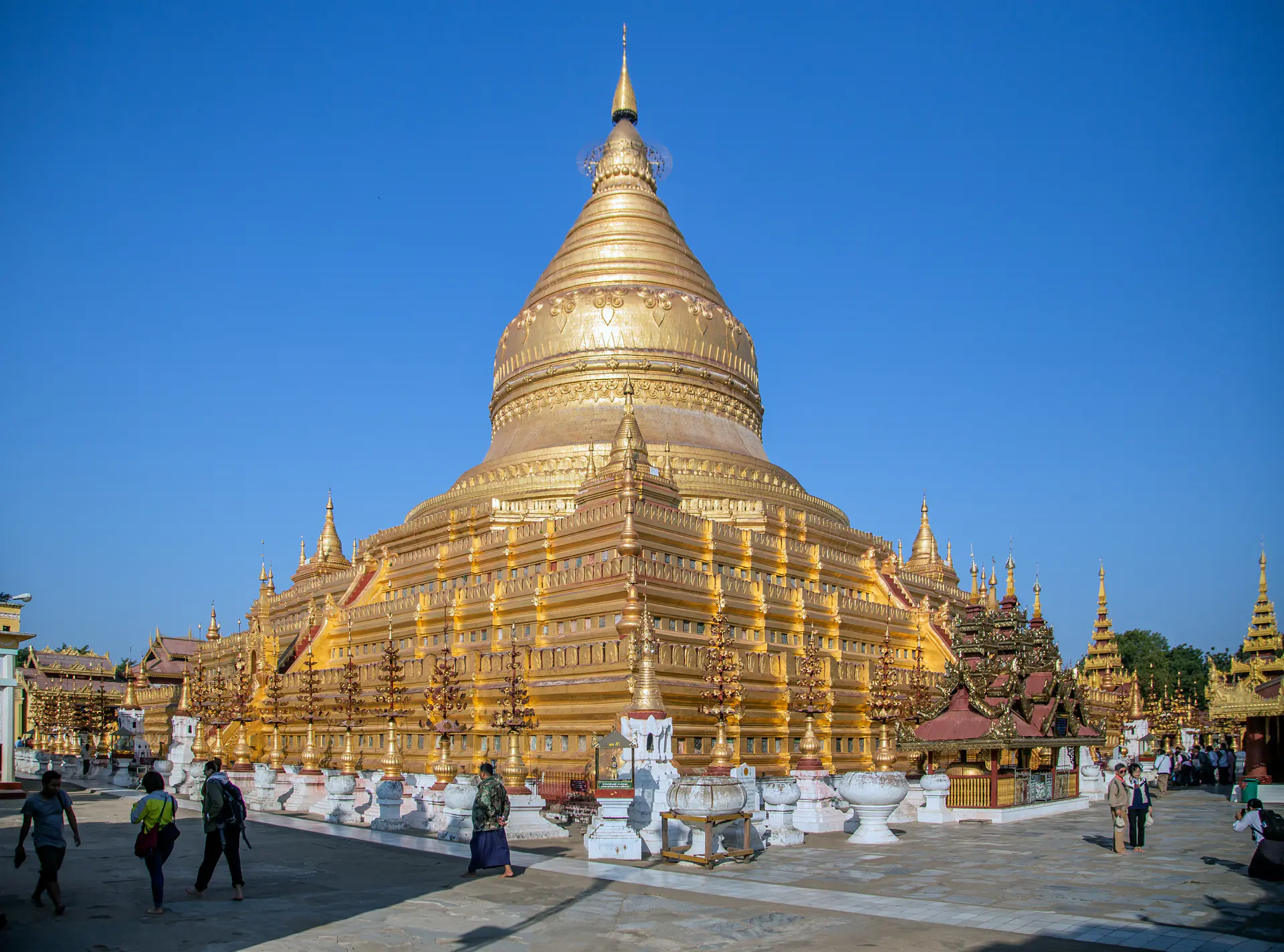
Visit the glittering golden stupa that established the architectural template for pagodas throughout Myanmar, believed to contain relics of the Buddha himself. Kings Anawrahta and Kyansittha constructed Shwezigon Pagoda between 1059-1102, enshrining what tradition holds to be a tooth and bone of Gautama Buddha along with a copy of the sacred tooth relic from Sri Lanka. The massive bell-shaped golden stupa rises from three square terraces adorned with glazed terracotta plaques depicting jataka tales. Four Buddha shrines at cardinal points house bronze standing Buddhas, while the enclosure contains 37 nat (spirit) statues representing pre-Buddhist worship incorporated into the new faith. Shwezigon remains an active pilgrimage destination with annual festivals drawing thousands.
Pro tip: Visit Shwezigon Pagoda during late afternoon when golden light intensifies the gilded surface and devotees gather for evening prayers--the atmospheric religious activity provides cultural immersion impossible during rushed morning visits.
Recommended
Sunrise Over the Temple Plains
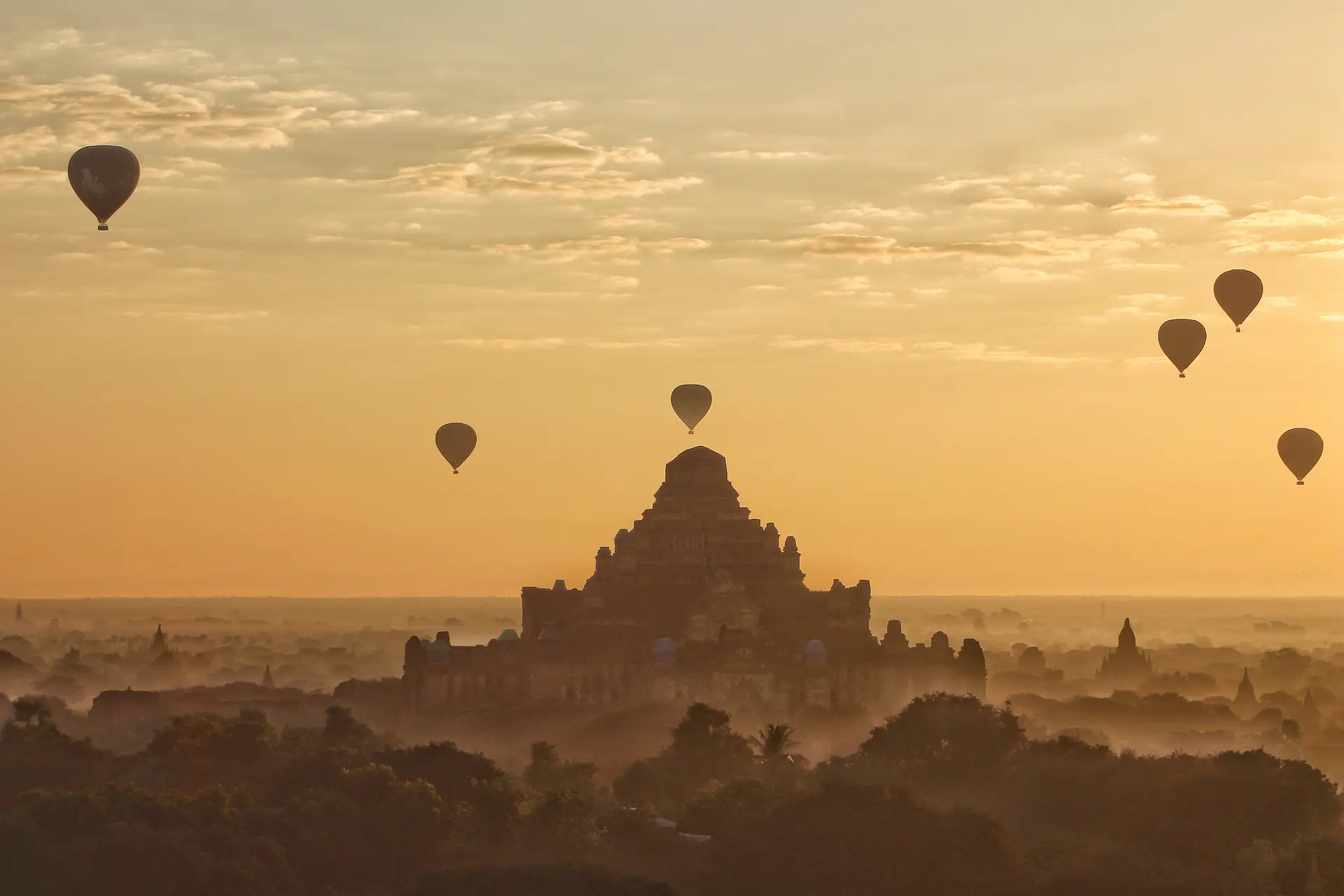
Experience Bagan's most magical moment as dawn light transforms the mist-shrouded plains into an ethereal landscape of ancient silhouettes. Since January 2018, temple climbing has been prohibited, but designated viewing mounds near Sulamani and Pwar Saw village provide panoramic vistas across the monument-studded horizon. Hot air balloon flights from November through February offer ultimate sunrise perspectives, drifting silently between temple spires as golden light creeps across 3,500 monuments. Ground-level sunrise viewing from designated spots captures temples emerging from morning mist with pastoral scenes of ox-carts adding timeless atmosphere. The Bagan Viewing Tower provides elevated perspective though purists prefer natural viewpoints.
Pro tip: Depart on e-bike around 4:45 AM to reach Sulamani Hill viewpoint before sunrise--arrive early to secure a good spot as viewing areas attract many visitors, and bring a flashlight for the dark approach through sandy paths.
Recommended
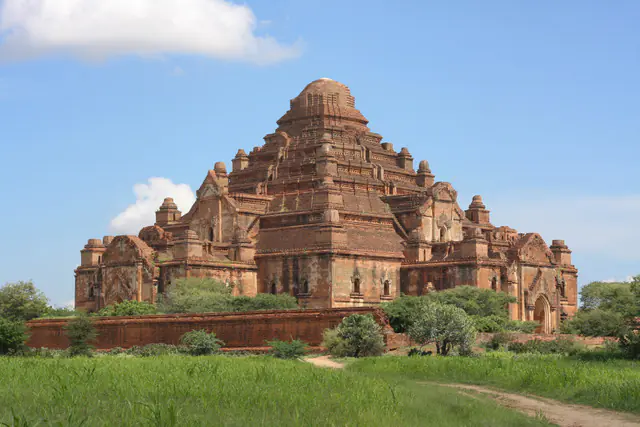
Dhammayangyi: The Massive Unfinished Temple
Explore the largest and most mysterious of Bagan's temples, a massive pyramid rising from the plain whose dark history matches its imposing presence. King Narathu built Dhammayangyi around 1167-1170, allegedly to atone for murdering his father and brother to seize the throne. The temple's exceptional brickwork features joints so precisely fitted that not even a needle can penetrate between bricks--legend holds Narathu ordered workers' hands cut off if mortar remained visible. Construction halted when assassins killed Narathu before completion, and inner passageways were mysteriously bricked up, possibly hiding victims or treasure. Despite its incomplete state, Dhammayangyi's massive profile dominates the Bagan skyline, visible from across the plain and serving as a landmark for navigation.
Pro tip: Visit Dhammayangyi at sunset when its silhouette creates dramatic photography--explore the ground-floor corridor to appreciate the legendary precision of brickwork making this temple architecturally unique among Bagan's monuments.
Historical Context
Foundation of the Pagan Kingdom (1044-1077)
King Anawrahta Minsaw unified the Irrawaddy Valley and established the Pagan Kingdom around 1044, adopting Theravada Buddhism after conquest of the Mon kingdom of Thaton. This initiated the remarkable era of temple construction as kings and donors sought merit through religious architecture, transforming the arid plain into a sacred landscape.
Golden Age of Temple Construction (1077-1287)
For 250 years, successive kings including Kyansittha, Alaungsithu, and Narathu oversaw the construction of over 10,000 Buddhist monuments. The practice of merit-making through temple donation became central to political power, with each ruler seeking to outdo predecessors in architectural magnificence. This period produced masterpieces including Ananda, Shwezigon, Dhammayangyi, and Thatbyinnyu temples.
Decline and Abandonment (13th-19th centuries)
Mongol invasions in 1287 effectively ended the Pagan Kingdom, though the city remained inhabited and temples continued receiving veneration. Subsequent centuries saw gradual decline as political power shifted elsewhere in Myanmar. Earthquakes, particularly in 1975, caused significant damage to monuments. By the colonial period, Bagan had become a quiet pilgrimage destination among its ancient ruins.
Military Era and Controversial Restoration (1990s-2016)
Myanmar's military government promoted tourism at Bagan while undertaking extensive but controversial restoration programs. Critics condemned reconstructions that rebuilt temples not to original form but to idealized designs, creating "terrible uniformity" that impaired authenticity. Villagers were relocated from Old Bagan to New Bagan in 1990, further altering the cultural landscape.
UNESCO Inscription and Ongoing Challenges (2019-present)
UNESCO inscribed Bagan as a World Heritage Site in July 2019, recognizing its outstanding universal value while acknowledging past restoration concerns. The 2016 earthquake damaged approximately 400 temples, prompting international conservation assistance. Temple climbing prohibition (2018) aimed to protect structures. Ongoing challenges include earthquake vulnerability, tourism management, and balancing conservation with religious use.
Conservation
Current Status
Bagan faces significant conservation challenges from earthquake vulnerability, past inappropriate restorations, and balancing heritage protection with continued Buddhist worship and tourism development. International cooperation following the 2016 earthquake has improved conservation practices, though comprehensive management systems remain under development.
Challenges
- Earthquake vulnerability in seismically active region, with the 2016 magnitude 6.8 earthquake damaging approximately 400 temples and demonstrating ongoing structural risks to ancient monuments
- Inappropriate past restorations during military era that rebuilt temples to idealized forms rather than historical accuracy, creating "terrible uniformity" that impaired authenticity and archaeological value
- Modern intrusions including hotels, roads, lamp posts, and infrastructure within the archaeological zone detracting from the historic landscape character and requiring strategic removal or screening
- Tourism pressure with visitor numbers increasing prior to COVID, creating wear on fragile structures and requiring careful site management to balance access with preservation
- Incomplete heritage management systems including Archaeological Risk Plan and Heritage Impact Assessment frameworks that remain under development rather than fully implemented
Conservation Efforts
- International cooperation following 2016 earthquake, with UNESCO, World Bank, ICCROM, and countries including India, China, Germany, Italy, Japan, and Korea providing technical expertise and funding for conservation
- Temple climbing prohibition since January 2018 protecting structural integrity while encouraging use of designated viewing mounds that distribute visitor impact
- Traditional craftsmanship programs training local artisans in historical building techniques including brick-making and lime mortar use for authentic restoration
- Archaeological documentation including 3D scanning and photographic surveys by organizations like CyArk preserving detailed records of monuments for future conservation reference
- UNESCO monitoring and State of Conservation reporting providing ongoing assessment and recommendations for improved site management and development controls
Frequently Asked Questions
Approximately 3,595 Buddhist temples, pagodas, and monasteries survive in Bagan's archaeological zone covering 104 square kilometers. At the peak of the Pagan Kingdom (11th-13th centuries), over 10,000 monuments existed. The density creates one of the world's most remarkable concentrations of Buddhist architecture.
The Bagan Archaeological Zone fee costs 25,000 MMK (~$12 USD) or $20-25 USD if paying in dollars. The ticket is valid for 3-5 days and can be purchased at the airport upon arrival or at ticket counters before entering the zone. Bring your passport for ticket purchase.
No, temple climbing has been prohibited since January 2018 to protect structures and ensure visitor safety. Previously popular temples for climbing are now closed to upper levels. Designated viewing mounds near Sulamani and other temples provide panoramic sunrise and sunset views as alternatives.
November-February offers ideal conditions with comfortable temperatures (20-30°C), no rain, and hot air balloon operations. Avoid March-May when temperatures exceed 40°C. June-October brings monsoon rains with afternoon thunderstorms but fewer tourists and lush green surroundings.
E-bikes (electric scooters) provide the best transportation, costing 6,000-10,000 MMK ($4-8 USD) per day. Motorbikes are prohibited for foreigners. Alternatives include bicycles (demanding in heat), horse-carts (traditional but pricier), and taxis or guided tours with air-conditioning.
Hot air balloon flights cost $300-400 USD per person for 45-60 minute sunrise experiences including champagne breakfast. Flights operate November-February only during cool, clear mornings. Book well in advance as popular dates sell out. Operators include Balloons Over Bagan and Oriental Ballooning.
Ananda Temple is considered Bagan's masterpiece, built in 1105 and revered as the "Westminster Abbey of Burma." Its perfect architecture blends Mon and Indian traditions. Shwezigon Pagoda holds highest religious significance as it contains Buddha relics and established the template for all Myanmar pagodas.
A magnitude 6.8 earthquake struck Bagan on August 24, 2016, damaging approximately 400 temples. UNESCO, World Bank, and multiple countries coordinated restoration efforts. Fortunately, the oldest and most significant temples including Ananda and Shwezigon suffered only minor damage.
Yes, UNESCO inscribed Bagan in July 2019 after a previous 1996 rejection due to ill-defined boundaries and inappropriate restorations. The successful inscription recognized Bagan's outstanding universal value while acknowledging past conservation challenges and the need for improved management.
Plan minimum 2-3 days for major temples including Ananda, Shwezigon, and Dhammayangyi plus sunrise and sunset viewing. 4-5 days allows comprehensive exploration of lesser-visited temples, lacquerware workshops, and possible day trip to Mount Popa. Hot air balloon riders should add a morning.
UNESCO World Heritage Criteria
Inscribed in 2019, this site meets 3 of UNESCO's 10 criteria for Outstanding Universal Value
III
Criterion (iii): Testimony to cultural tradition
Bagan bears exceptional testimony to the Pagan civilization that dominated the region from the 11th to 13th centuries, creating one of the world's densest concentrations of Buddhist monuments. The 3,595 surviving temples, pagodas, and monasteries preserve remarkable murals, sculptures, and inscriptions documenting the cultural flowering of medieval Southeast Asia.
IV
Criterion (iv): Outstanding architectural/technological ensemble
The archaeological landscape represents an outstanding example of Buddhist architecture and art, demonstrating the evolution of temple design across 250 years of intensive construction. Buildings ranging from simple stupas to sophisticated temples like Ananda illustrate the development of architectural traditions that influenced Buddhist architecture throughout mainland Southeast Asia.
VI
Criterion (vi): Associated with events/traditions/ideas/beliefs/artistic works
Bagan is directly associated with the spread of Theravada Buddhism through mainland Southeast Asia and the tradition of merit-making through temple construction. The practice of kings and donors building temples to accumulate merit became a model for subsequent Buddhist kingdoms in present-day Thailand, Laos, and Cambodia, fundamentally shaping regional religious practice.
Image & Content Attribution
Research & Content Sources
Photography & Visual Media
Vyacheslav Argenberg, CC BY 4.0
Gerd Eichmann, CC BY-SA 3.0
David.Clay.Photography, CC BY-SA 4.0
Mrsoethuaung, CC BY 4.0
Lucanos, CC BY-SA 3.0
Last updated: 20 December 2025