

Turkey • UNESCO World Heritage Site
Ephesus: Library of Celsus & Ancient Roman City
Monumental Marble Streets and Classical Architecture
Inscribed: 2015
Category: Cultural
ID: #1018
What Is Ephesus and Why Visit?
Greek colonists from Athens founded Ephesus in the 10th century BCE on the Aegean coast to establish a trading port controlling maritime routes between Greece and Asia Minor. Under Roman rule beginning in 129 BCE, Ephesus transformed into the provincial capital of Asia with a population exceeding 250,000 inhabitants, making it the second-largest city in the empire. The marble-paved streets connected monumental structures including the 12,000-scroll Library of Celsus, the 25,000-seat Great Theater where St. Paul preached, and luxurious Terrace Houses with elaborate mosaics revealing the prosperity of this cosmopolitan center. The city housed the Temple of Artemis, one of the Seven Wonders, until its destruction in 401 AD.
Why It Matters
Ephesus provides exceptional testimony to Greco-Roman urban civilization through its remarkably preserved temples, theaters, libraries, and residential quarters. The city represents a crucial crossroads where Greek democratic traditions, Roman imperial power, and early Christianity converged, creating a cosmopolitan center that profoundly shaped Western cultural development across multiple historical periods.
How to Visit Ephesus
Essential information for visiting this destination
How to Get to Ephesus
Izmir Adnan Menderes Airport (ADB) serves as the nearest international gateway, located 60 kilometers north of Ephesus with connections to major European cities and domestic Turkish destinations. Airport shuttle buses operate to Selcuk town (adjacent to Ephesus) requiring approximately 1 hour, while private transfers and rental cars offer flexible alternatives. From Izmir city center, frequent trains (izban) and buses connect to Selcuk requiring 60-90 minutes.
Kusadasi cruise port 20 kilometers west receives Mediterranean cruise ships, with shuttle buses and taxis providing access to Ephesus for day visitors. Within Selcuk, Ephesus archaeological site entrance lies 3 kilometers from town center, accessible via taxi, dolmus (shared minibus), or organized tours.
Best Hotels Near Ephesus
Selcuk town immediately adjacent to Ephesus offers extensive accommodation from budget pensions to boutique hotels, with most properties within walking distance of restaurants and Ephesus Museum. Family-run guesthouses along Cengiz Topel Caddesi provide authentic Turkish hospitality and breakfast featuring local specialties, while boutique hotels in restored Ottoman houses deliver historic atmosphere with modern amenities.
Kusadasi coastal resort 20 kilometers west features larger hotels and beach access, though requires transportation to reach Ephesus. Izmir city 80 kilometers north provides urban accommodation and dining options for visitors combining multiple destinations.
Book months ahead for April-May and September-October peak seasons when properties fill with tour groups and independent travelers. Summer months (June-August) see extreme heat but better accommodation availability.
Where to Eat Near Ephesus
Traditional Turkish cuisine flourishes in Selcuk restaurants, with local specialties including manti (Turkish dumplings), kofte (grilled meatballs), pide (Turkish flatbread pizza), and fresh Aegean seafood. Mehmet and Ali Baba restaurants near the ancient aqueduct earn recommendations for authentic cooking at reasonable prices. Meze platters featuring stuffed grape leaves, eggplant dishes, and yogurt-based cacik provide perfect sharing meals.
Turkish breakfast (kahvalti) served at guesthouses and cafes includes fresh bread, local cheeses, olives, honey, jams, and seasonal vegetables--essential fuel before exploring archaeological sites in Mediterranean heat. Turkish tea (cay) and strong coffee (turk kahvesi) accompany meals throughout the day.
Within the archaeological site, limited food facilities exist--most visitors return to Selcuk for lunch or bring snacks and water for sustained exploration.
Ephesus Entry Fees & Tour Prices
Ephesus entry costs TRY 650 ($19 USD) for the main archaeological site, with Terrace Houses requiring separate ticket TRY 650 ($19 USD) additional. Museum Pass Aegean TRY 1,300 ($38 USD) covers Ephesus, Terrace Houses, Ephesus Museum, and 10+ sites across the region over 7 days. Purchase online at www.muze.gov.tr or at site entrance. Turkish citizens and students receive discounted rates.
Licensed guides cost TRY 1,700-3,400 ($50-100 USD) for 2-3 hour tours providing essential historical context and archaeological insights. Audio guides available for self-guided exploration. Most visitors spend 3-4 hours in main site, adding 1-2 hours for Terrace Houses.
House of Virgin Mary 7 kilometers south costs TRY 170 ($5 USD), marking the traditional site where Mary spent her final years according to Catholic tradition. Ephesus Museum in Selcuk displays artifacts including Artemis statues, frescoes, and everyday objects. Sirince village 8 kilometers east offers traditional stone houses, fruit wines, and authentic Turkish village atmosphere for afternoon excursions.
What to Bring to Ephesus
Comprehensive travel insurance covering medical emergencies is essential for international visits to Turkey. Turkish eSIM cards provide convenient data packages activated before departure, enabling immediate connectivity for navigation and communication throughout the country. Local SIM cards available in Selcuk and Izmir offer competitive alternatives with good coverage across western Turkey.
Turkey uses Type C and F electrical outlets (220V), requiring plug adapters for British three-pin and American two-flat-pin devices. Summer temperatures in Selcuk regularly exceed 38°C with intense Mediterranean sun and limited shade at archaeological sites. Pack sun protection including wide-brimmed hat, high-SPF sunscreen, and light, breathable clothing layers.
Comfortable walking shoes with good grip essential for marble streets and uneven ancient paving. Carry abundant water supplies during site visits. Modest dress recommended when visiting religious sites including House of Virgin Mary.
Loading map...
Visitor Information
Everything you need to know for your visit
What to Bring
Sturdy walking shoes essential for marble streets that become extremely slippery when polished or wet. Bring wide-brimmed hat and high-SPF sunscreen for intense Mediterranean sun with limited shade. Carry abundant water (2 liters minimum) as summer temperatures exceed 38°C. Pack light layers for temperature fluctuations. Bring camera with good zoom for architectural details.
Accessibility
Wheelchair access available through designated pathways and ramps to major monuments including Library of Celsus and Great Theater. Cobblestone and marble streets create challenges in some areas. Golf carts available for mobility-impaired visitors. Contact site administration in advance for accessibility arrangements and assistance.
Safety Tips
Marble and stone surfaces extremely slippery, especially ancient polished sections. Wear appropriate footwear with good grip. Summer temperatures exceed 38°C with minimal shade along main routes. Carry ample water and rest frequently. Watch for uneven ancient paving and steps. Follow designated pathways to protect archaeological remains.
Architectural Treasures of the Ancient World
Must-See
Library of Celsus
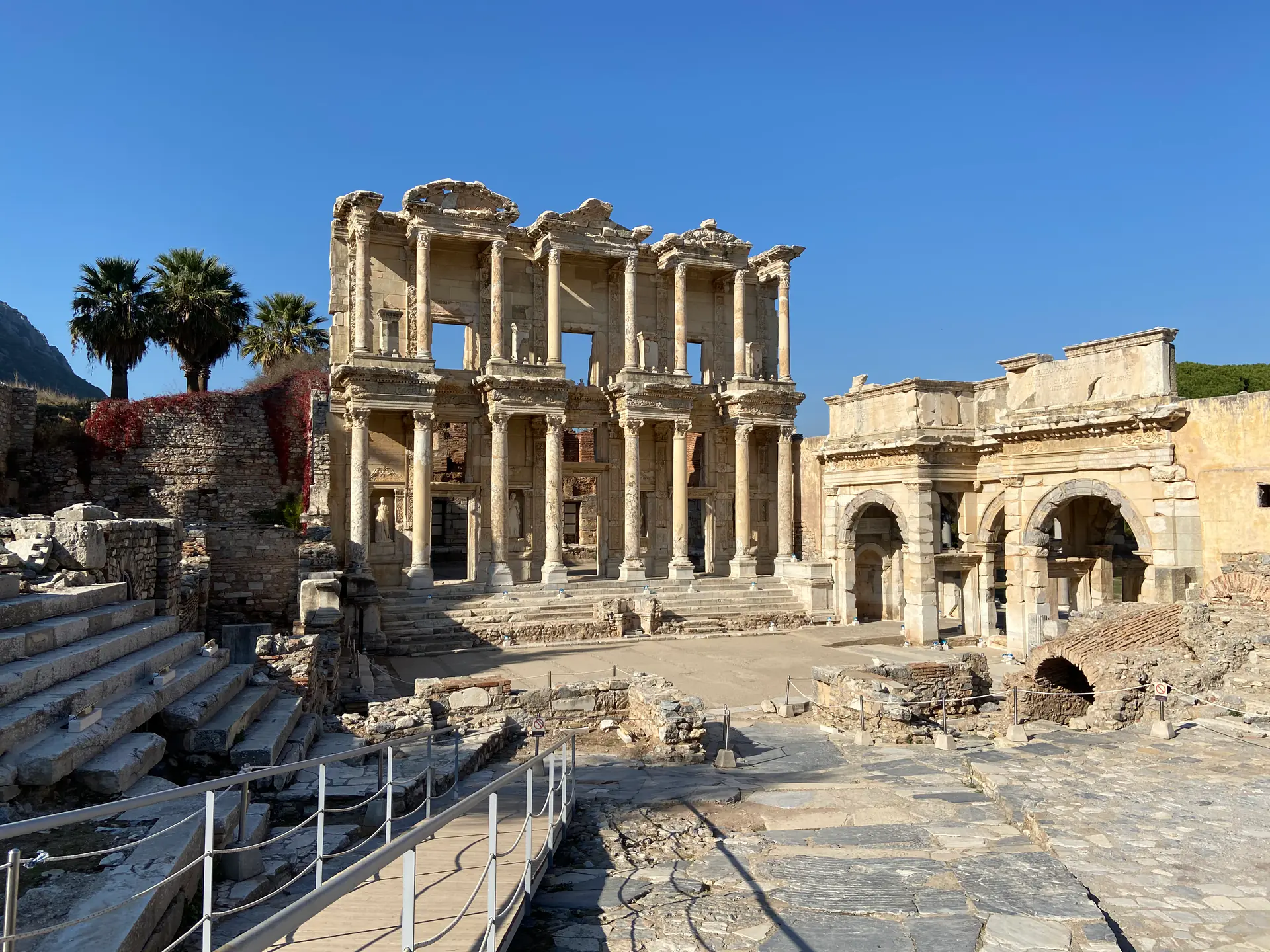
The Library of Celsus stands as one of antiquity's most magnificent libraries, built in 117 AD by Gaius Julius Aquila to honor his father, Roman Senator Tiberius Julius Celsus Polemaeanus. The two-story facade rises 16 meters high with exquisite Corinthian columns and four sculptural niches representing Wisdom, Knowledge, Intelligence, and Valor. The reading room once housed 12,000 scrolls stored in wall niches designed to protect manuscripts from humidity. The building's architectural genius lies in its optical illusions--columns taper and central elements appear larger, creating the impression of greater height when viewed from Marble Street.
Pro tip: Arrive at Ephesus opening time (8am) and head directly to the Library of Celsus before tour groups arrive--you can photograph the facade without crowds for 20-30 minutes, capturing perfect morning light illuminating the sculptural details.
Must-See
Great Theater
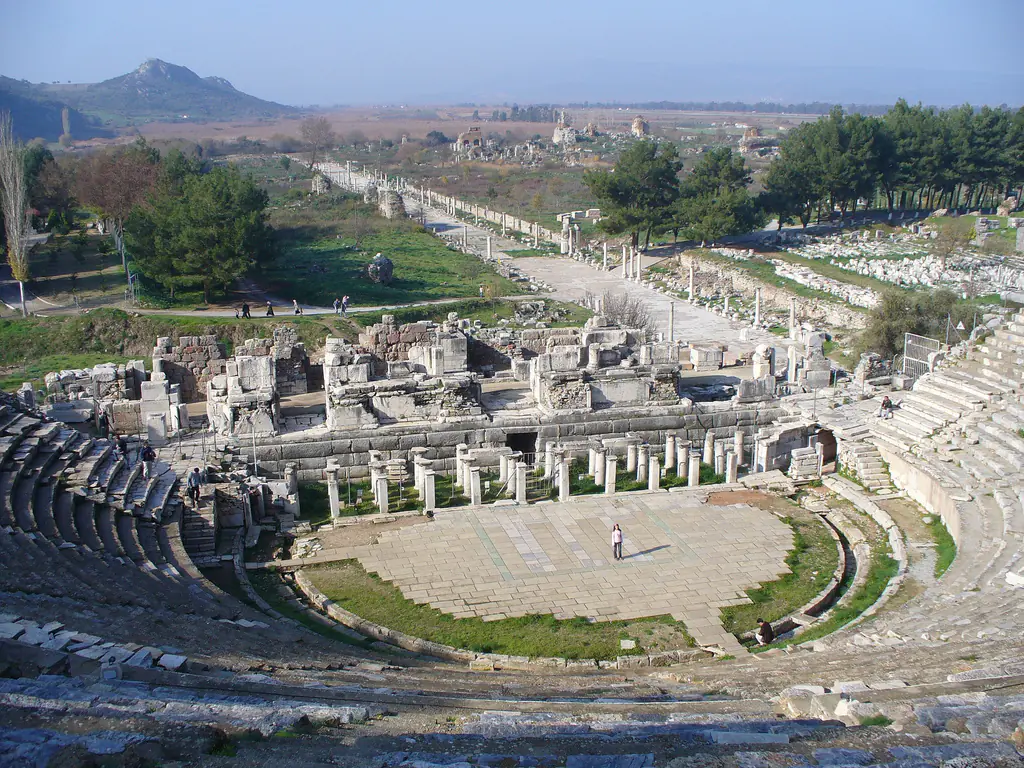
The Great Theater represents one of the largest ancient theaters in the Mediterranean world, carved into Mount Pion's western slope with capacity for 25,000 spectators. Originally constructed during the Hellenistic period, Emperor Trajan expanded the structure in the 2nd century AD to its current scale. The theater hosted dramatic performances, musical concerts, and gladiatorial contests while serving as the site where St. Paul addressed Ephesians during his missionary journeys around 52-54 AD. The acoustic engineering remains so sophisticated that a coin dropped on the orchestra floor can be heard from the top row. Visitors can climb steep seating tiers for panoramic views across the ancient city.
Pro tip: Climb to the theater's upper tiers in late afternoon for spectacular sunset views over the ancient Harbor Street and surrounding archaeological site--bring water for the climb and allow 30 minutes to explore the full structure.
Recommended
Terrace Houses
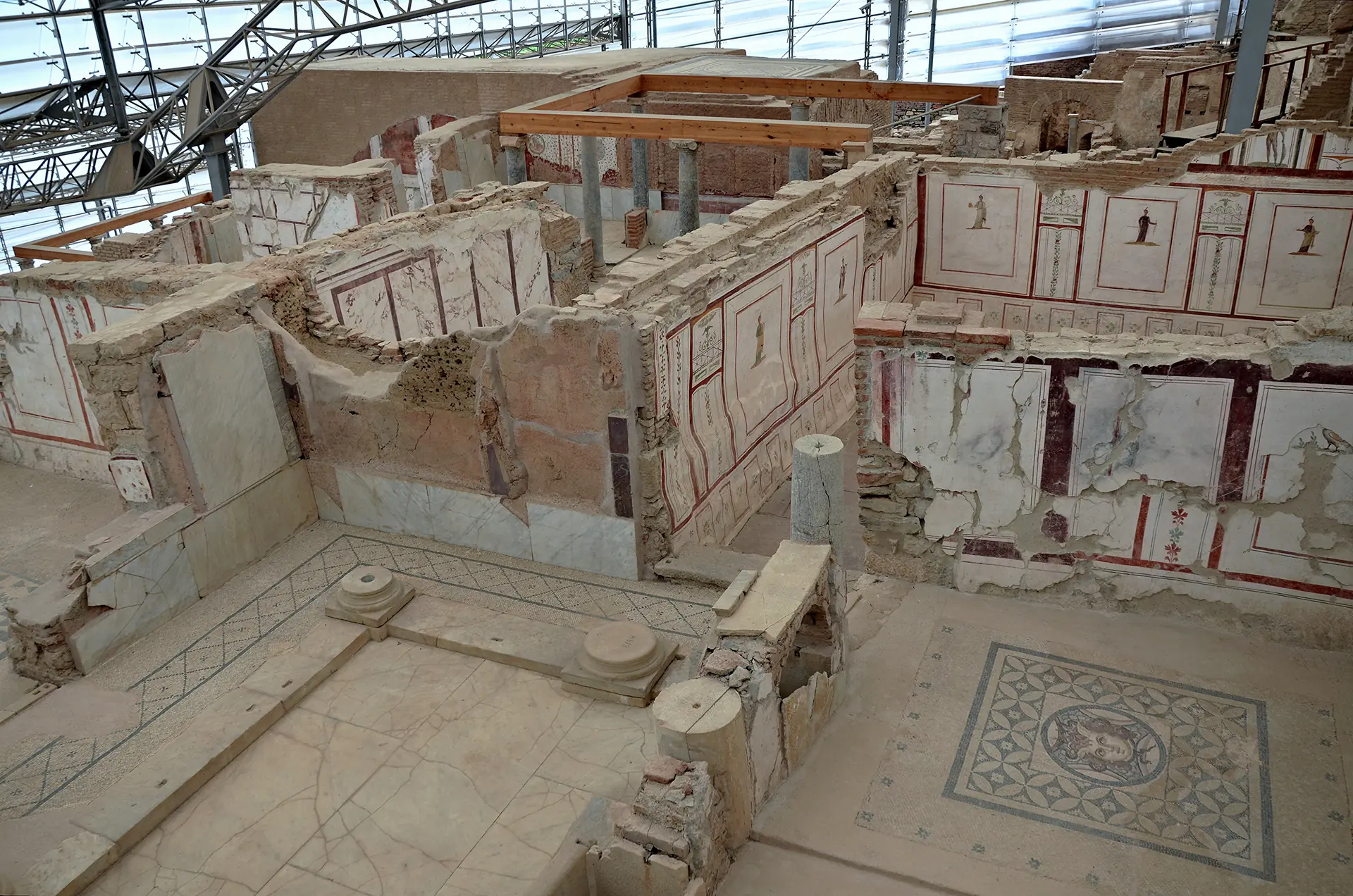
The Terrace Houses reveal the luxurious lifestyle of Ephesus's wealthy elite through remarkably preserved residential complexes dating from the 1st to 7th centuries AD. These multi-story Roman villas feature intricate mosaic floors depicting mythological scenes, frescoed walls with geometric and floral patterns, and sophisticated under-floor heating systems (hypocaust) alongside running water and private bathrooms. Archaeological excavations uncovered dining rooms (triclinia), courtyards with marble fountains, and storage rooms containing everyday objects from ancient household life. The preservation beneath protective roofing allows visitors to observe conservation work in progress while experiencing the artistic sophistication and engineering excellence that characterized wealthy Roman urban living in provincial Asia.
Pro tip: Purchase the separate Terrace Houses ticket (TRY 650/$19 USD extra) which many visitors skip--these houses offer the site's most impressive mosaics and frescoes with far fewer crowds than the main monuments, making it exceptional value for history enthusiasts.
Recommended
Marble Streets and Urban Planning
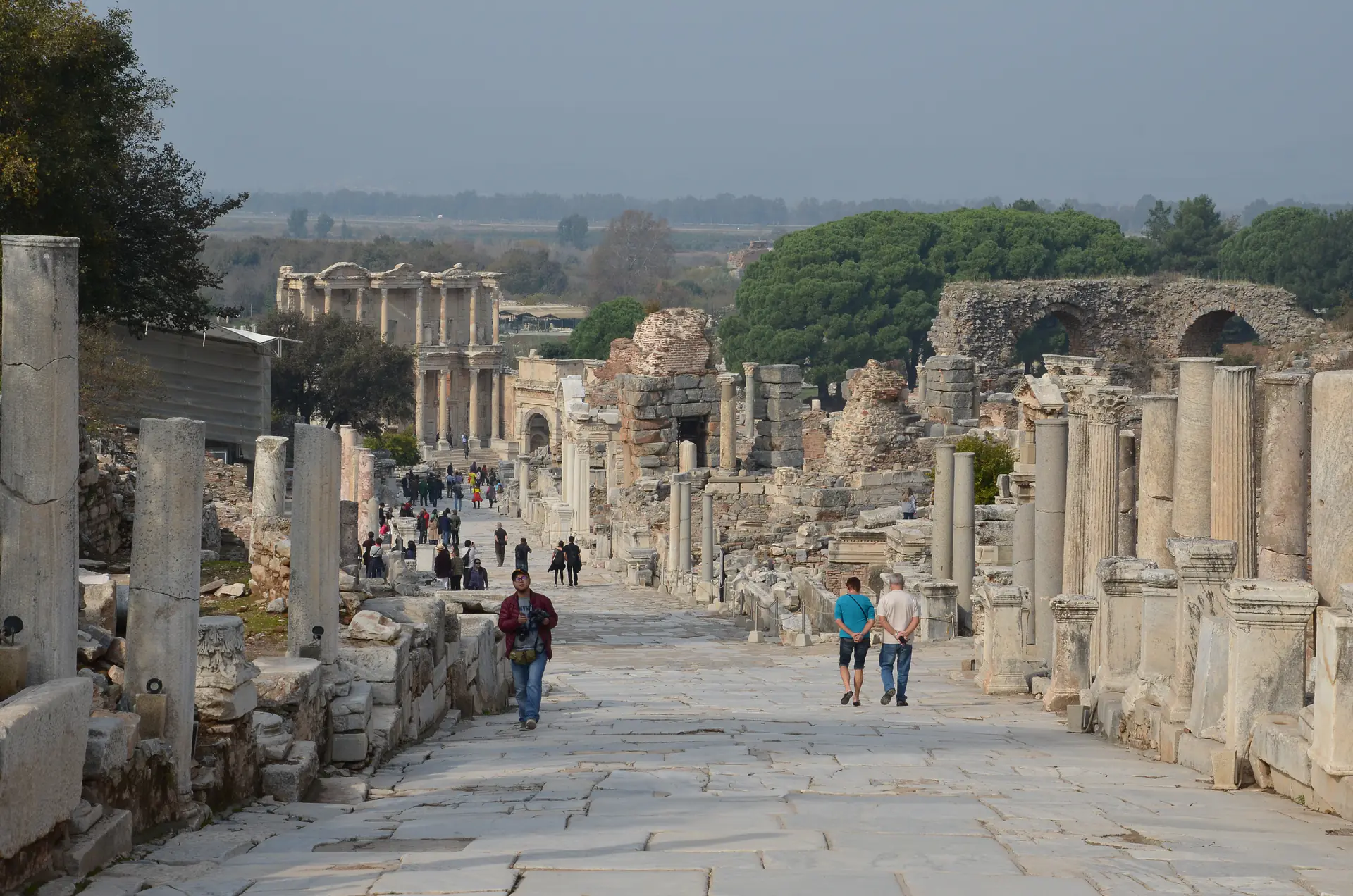
Ephesus's marble-paved streets demonstrate exceptional Roman urban planning and engineering, with Curetes Street and Marble Street serving as the main thoroughfares connecting religious, civic, and commercial districts. These streets feature sophisticated drainage systems with channels carved beneath the polished surface, colonnade walkways providing shade for pedestrians, and street lighting infrastructure. Along these routes, visitors encounter the Temple of Hadrian with its ornate arch, public latrines with marble seating, commercial agora remains, and numerous statue bases. The Harbor Street stretched 530 meters from the theater to the ancient harbor, lined with marble columns and street lamps.
Pro tip: Walk Curetes Street slowly downhill from the Upper Gate to the Library--this route follows the ancient processional path and allows you to appreciate architectural details, inscriptions, and relief carvings that most rushed visitors miss in their hurry to reach the famous monuments.
Historical Context
Greek Foundation (10th century BCE)
Athenian colonists founded Ephesus as an Ionian Greek settlement on the Aegean coast, establishing a strategic port controlling maritime trade routes. The city became one of twelve cities in the Ionian League, developing temples to Artemis and fostering Greek cultural traditions that would persist for millennia.
Temple of Artemis (6th century BCE - 401 AD)
Ephesians constructed the massive Temple of Artemis around 550 BCE, creating one of the Seven Wonders of the Ancient World. This sanctuary attracted pilgrims from across the Mediterranean world, making Ephesus a major religious center and accumulating enormous wealth through offerings and temple banking activities over eight centuries.
Roman Provincial Capital (129 BCE - 3rd century)
Under Roman control from 129 BCE, Ephesus flourished as the provincial capital of Asia, reaching its architectural zenith during the 1st-2nd centuries AD with construction of the Library of Celsus, expansion of the Great Theater, and development of Terrace Houses. The city's population exceeded 250,000.
Early Christianity (1st-4th centuries AD)
St. Paul preached in Ephesus around 52-54 AD, establishing significant early Christian communities. The city hosted the Third Ecumenical Council in 431 AD and became associated with both St. John the Apostle and Virgin Mary, transforming from pagan religious center to crucial early Christian site that shaped theological development.
Byzantine Decline (5th-14th centuries)
Harbor silting and Arab raids during the 7th-8th centuries initiated Ephesus's gradual decline. The population relocated to nearby Ayasuluk Hill (modern Selcuk), abandoning the ancient city. By the 15th century, Ephesus lay buried until Austrian archaeologist Johann Keil began systematic excavations in 1863.
Conservation
Current Status
Comprehensive conservation programs protect Ephesus through international collaboration, advanced monitoring technology, and systematic restoration employing original materials and traditional techniques.
Challenges
- Marble deterioration accelerated by air pollution, acid rain, and salt crystallization from proximity to Aegean Sea requiring specialized conservation treatments
- Tourism pressure from over 2 million annual visitors causing physical wear on ancient marble streets, steps, and architectural elements throughout the archaeological site
- Seismic activity in geologically active western Turkey threatening structural stability of standing monuments including the Library of Celsus facade and Great Theater seating tiers
- Vegetation growth and root penetration damaging foundations and wall structures in areas awaiting excavation or restoration, requiring ongoing monitoring and maintenance
Conservation Efforts
- Advanced protective roofing systems over Terrace Houses preserve delicate mosaics and frescoes while allowing visitor access and ongoing conservation work under controlled environmental conditions
- Systematic marble restoration programs employ traditional techniques and materials, replacing damaged elements with compatible stone while preserving original fragments for museum display and study
- Digital documentation using laser scanning and photogrammetry creates comprehensive 3D records of monuments, enabling precise monitoring of structural changes and informed conservation planning
- Visitor pathway management routes traffic through reinforced areas, protecting fragile surfaces while maintaining access to major monuments through designated walking routes and viewing platforms
Frequently Asked Questions
Absolutely essential for anyone interested in ancient history. Ephesus ranks among the best-preserved Roman cities in the Mediterranean, featuring the spectacular Library of Celsus, massive Great Theater seating 25,000, and luxurious Terrace Houses with stunning mosaics. Plan 3-4 hours minimum. Best visited March-May or September-November.
Ephesus entry costs TRY 650 ($19 USD). Terrace Houses require separate ticket TRY 650 ($19 USD) additional. Museum Pass Aegean TRY 1,300 ($38 USD) covers both plus Ephesus Museum and regional sites over 7 days. Guided tours cost TRY 1,700-3,400 ($50-100 USD).
Advance booking recommended during peak season (April-May, September-October) though not mandatory. Purchase Museum Pass online at www.muze.gov.tr for convenience. For guided tours, book 2-3 days ahead. Arrive early (8am opening) to avoid cruise ship groups arriving 10am-2pm.
March through May and September through November offer ideal weather with mild temperatures. Visit early morning (8am) or late afternoon to avoid midday heat and crowds. Summer (June-August) sees extreme heat exceeding 38°C. Winter provides comfortable temperatures but shorter daylight hours.
Plan minimum 3-4 hours for main archaeological site covering Library of Celsus, Great Theater, Marble Street, and Temple of Hadrian. Add 1-2 hours for Terrace Houses. Full day recommended including Ephesus Museum and House of Virgin Mary. Start early to avoid heat and crowds.
Ephesus lies 20 kilometers (25 minutes) from Kusadasi cruise port. Taxis cost TRY 850-1,100 ($25-32 USD) round-trip. Shore excursions arranged through cruise lines provide guided tours. Independent travelers can hire taxis or join shared tours from port area. Allow 4-5 hours minimum for port visit.
Ephesus was a major Greek and Roman city on Turkey's Aegean coast, famous for exceptional preservation of classical architecture including the Library of Celsus, Great Theater seating 25,000, and luxurious Terrace Houses. The city housed the Temple of Artemis (one of Seven Wonders) and became an important early Christian center.
Visitors explore marble-paved streets connecting the Library of Celsus facade, massive Great Theater, Temple of Hadrian, public latrines, commercial agora, and Terrace Houses with stunning mosaics and frescoes. The 3-kilometer walking route descends through remarkably preserved Roman urban planning. Nearby sites include Ephesus Museum and House of Virgin Mary.
Greek colonists from Athens founded Ephesus in the 10th century BCE. The city reached its zenith as Roman provincial capital of Asia during the 1st-2nd centuries AD, when authorities constructed the Library of Celsus (117 AD) and expanded the Great Theater to seat 25,000 spectators.
Wear sturdy walking shoes with good grip for marble streets. Bring sun protection including wide-brimmed hat and high-SPF sunscreen for limited shade. Light, breathable clothing essential for heat. Carry 2 liters water minimum. Modest dress recommended for visiting House of Virgin Mary.
Yes, visitors can climb the Great Theater seating tiers to reach upper levels for panoramic views across the ancient city. The steep steps require reasonable fitness. Late afternoon provides best photography lighting. Allow 20-30 minutes to climb and explore the full structure safely.
UNESCO World Heritage Criteria
Inscribed in 2015, this site meets 3 of UNESCO's 10 criteria for Outstanding Universal Value
III
Criterion (iii): Testimony to cultural tradition
Ephesus provides exceptional testimony to successive Hellenistic and Roman civilizations through its remarkably preserved urban fabric. The city represents a unique cultural crossroads where Greek democratic traditions, Roman imperial administration, and early Christian communities converged, creating a cosmopolitan center that profoundly influenced Mediterranean cultural development across multiple historical periods.
IV
Criterion (iv): Outstanding architectural/technological ensemble
The archaeological site exemplifies outstanding Greco-Roman urban planning and architectural achievement through monuments including the Library of Celsus, Great Theater, and Terrace Houses. These structures demonstrate sophisticated engineering, artistic excellence, and civic organization that characterized prosperous Roman provincial capitals during the empire's zenith.
VI
Criterion (vi): Associated with events/traditions/ideas/beliefs/artistic works
Ephesus remains directly associated with early Christianity's formative period, hosting St. Paul's missionary work around 52-54 AD and the Third Ecumenical Council in 431 AD. The city's connection to St. John the Apostle and Virgin Mary makes it profoundly significant for Western theological development.
Image & Content Attribution
Research & Content Sources
Photography & Visual Media
Benh, CC BY-SA 3.0
Hunterbloor, CC BY-SA 4.0
QuartierLatin1968, CC BY-SA 2.0
Carole Raddato, CC BY-SA 2.0
Thesupermat2, CC BY 2.0
Last updated: 15 January 2025